Before the hilltop village, life beside the Agly
Archaeological investigations during the construction of the dam revealed early occupation of the valley, including a Neolithic burial ground. Caramany's history therefore begins long before the façades we see today.
In the Middle Ages, an early settlement developed at l'Horto, near today's cemetery. Houses later gathered at the foot of the castle during a period of insecurity. In 1258, the Treaty of Corbeil brought the Fenouillèdes into the Kingdom of France: Caramany then stood in a borderland.
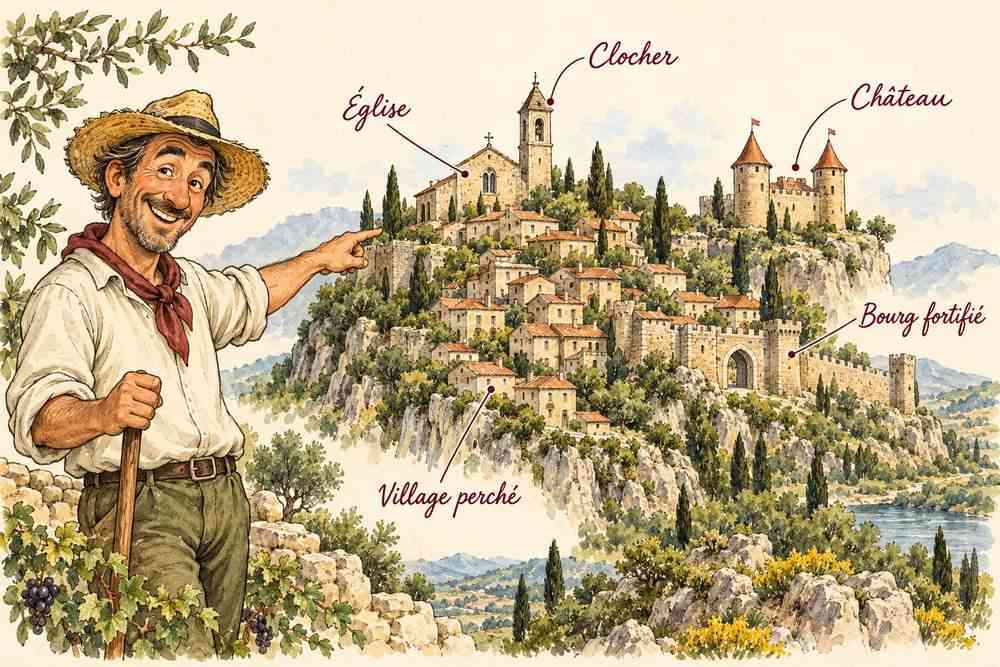
The castle, a landmark shaped by centuries
The castle occupies the rocky summit around which the village developed. Its present quadrangular form is the result of successive alterations. The municipality notes that little is known about its earliest structures and that its former defences cannot be reconstructed with certainty.
In 1792, the building was divided and sold to village families, a stage that helps explain its present appearance. From public spaces, look at the relationship between its walls, the terrain and neighbouring houses: the castle is also part of Caramany's residential history.
At Rebelli, imagine entering the fortified village
At the end of rue de la Placette, the Rebelli gate is a tangible reminder of the village walls. The municipal listing recalls that an inventory from 1305 already described Caramany as a settlement surrounded by a crenellated rampart.
The municipality also points out the gate's hinges and the defensive opening above it. These details make the stop worthwhile: the entrance to the homes was also a passage to defend. Take time to examine the masonry and opening before continuing through the streets.
Saint-Étienne, one church after another
The name Saint-Étienne is associated with two places in local history. The first church stood at l'Horto, in the centre of today's cemetery. Its last remains were removed in 1882 when the cemetery was enlarged.
The church visible in the village was built near the castle. According to the municipality, its oldest parts date from the early 15th century. Originally smaller, it evolved with the parish and residents' needs. This sequence explains why Caramany's religious history is not confined to a single building.
The bell tower, a shared ambition
The municipality gives 1848 as the key date for the bell tower that became Caramany's emblem. It associates its construction with the priest François Bria and mayor Jean Estève-Peyrot, despite the village's financial difficulties. The church's history also highlights residents' participation in the work.
Its distinctive outline is a landmark during your walk. Look at it from several streets: its place among the roofs shows how a 19th-century structure became part of a much older village.
Link the landmarks during your visit
For a first visit, use the Rebelli gate, the surroundings of the castle and Saint-Étienne church as landmarks. This is a suggested visit to adapt to the passages open on site, rather than a waymarked circuit.
The village is still lived in: respect private entrances and ask the town hall about building opening arrangements or guided visits. Then step back to take in the landscapes of Caramany : the landmarks you have just seen take their place in the village's outline.